What Happens When You Click a Shortened Link?
Sometimes the shortest links hide the longest stories.
Shortened links appear in messages, social posts, QR codes, emails, and official communications. Most are harmless. Some are not. The important part is understanding what happens after you click.
Open the app
Try the idea in VennURL.
Paste a URL into VennURL to inspect the destination, review redirects, check connection details, and understand what deserves attention before opening. VennURL is built around a simple principle: understand first, then act.
01
Redirects
A useful signal only when it is explained in context.
02
Destination
A useful signal only when it is explained in context.
03
Tracking
A useful signal only when it is explained in context.
A Link That Tells You Almost Nothing.
A message like 'check this out' followed by a bit.ly link asks you to make a decision with almost no context. Many people click anyway because shortened links are now part of everyday life.
The interesting question is not whether shortened links are good or bad. It is what actually happens after you click one.
Why Do Shortened Links Exist?
Originally, shortened links solved a practical problem. Long URLs looked terrible, were hard to remember, and did not fit well into short messages.
A short link like bit.ly/abc123 is cleaner than a 300-character URL. The convenience is real, but it comes with a trade-off.
https://example.com/documents/2026/reports/final-version-v12?utm_source=email&utm_campaign=springWhat Actually Happens After You Click?
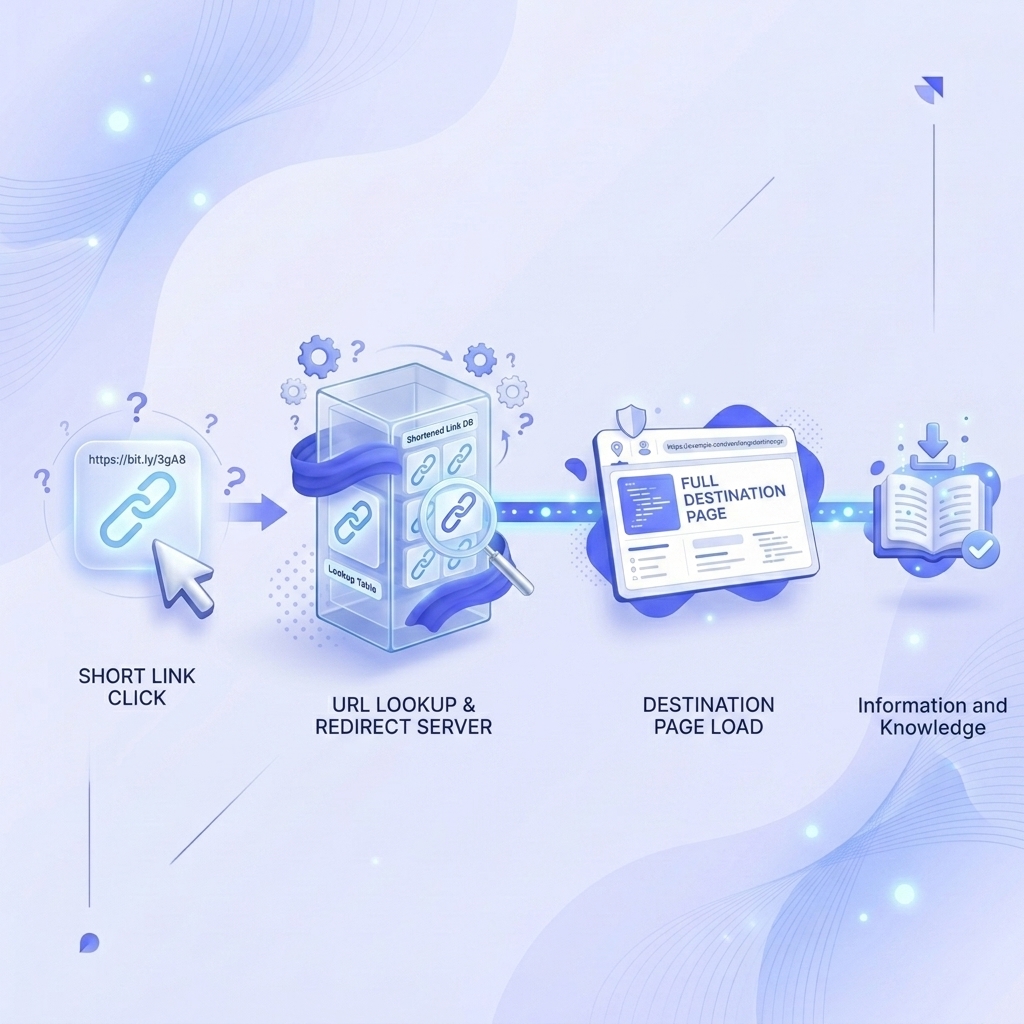
A shortened link is like a forwarding address. It sends your browser to the shortener first, then the shortener looks up the real destination and redirects you.
You click

bit.ly

Looks up the real destination

Redirects your browser

You arrive at the final website
The Problem Is Not the Redirect.
Redirects are normal. Companies use them when moving websites. Applications use them after login. Payment providers use them during checkout.
The issue is that a shortened link hides information before the click. The destination becomes invisible.
You Cannot See Where You Are Going.
Before clicking, you do not know whether the short link leads to a familiar destination or a suspicious lookalike. The shortener removes the context people use to decide whether something deserves trust.
bit.ly/abc123

github.com

example-bank-security-login.net
Why Shortened Links Feel Risky.
Where does this go?
People often hesitate around shortened links because they cannot answer that simple question. The uncertainty, not the technology itself, creates discomfort.
Shortened Links Are Not Bad.
Millions of legitimate businesses, universities, developers, marketers, and public organizations use shorteners. The issue is not the short link itself. The issue is that the destination becomes invisible.
Why Attackers Like Them.
If someone wants to disguise a suspicious destination, a shortener helps. A domain that would normally raise questions disappears behind a neutral-looking short link.
free-crypto-wallet-verification-example.com

bit.ly/abc123
Redirects Can Become Stories.
Some links redirect more than once. Each step may be legitimate, or it may deserve review. Without visibility into the chain, it is hard to know.
bit.ly

marketing.example.com

login.example.com

app.example.com
Tracking Is Another Piece of the Puzzle.
Many shortened links include tracking. That does not automatically make them harmful. It simply means someone wants to measure who clicked, when, where, or how often.
Removing unnecessary tracking does not change where a link goes. It reduces the amount of information shared about your visit.
- utm_source
- utm_campaign
- fbclid
- gclid
What You Should Look For Instead.
Rather than asking only whether a link is shortened, ask better questions.
- Where does it finally lead?
- Does the destination match what I expected?
- Does it redirect several times?
- Is the final website using HTTPS?
- Does the destination have a valid SSL certificate?
- Does anything about the final domain seem unusual?
This Is Why VennURL Exists.
At VennURL, we do not think shortened links are the enemy. Blind links are the problem.
When VennURL inspects a shortened link, it helps reveal where the link ultimately goes, how many redirects occurred, whether HTTPS is enabled, whether the certificate is valid, whether tracking can be removed, and whether anything deserves closer attention.
Final Thought.
Where does this really go?
Shortened links are not the problem. Hidden destinations are.
Trust does not come from making URLs shorter. It comes from making them easier to understand.
Understanding comes before action.
VennURL helps people review destinations, context, and warning signs before deciding what to do next.
Related reading
Keep building context with these VennURL notes.
June 20, 2026
Understanding redirect chains
The page you expect is not always the page you reach. Learn how redirects reveal the journey behind a click.
June 20, 2026
Why website age is not everything
An older domain can be reassuring, but domain age should never be the only reason you trust a website.
June 20, 2026
The difference between HTTPS and trust
HTTPS protects your connection. Trust depends on the context that helps you decide whether to connect in the first place.
Continue the Conversation
Follow VennURL for more thoughts on URL intelligence, web trust, and building a calmer internet.